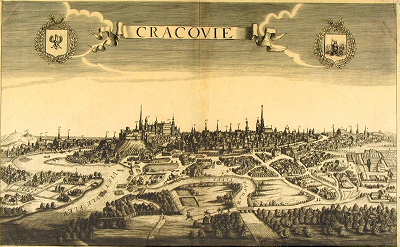
Day 1: Krakow - Old Town
Afternoon/evening: Arrival in Kraków. Check-in at the hotel. Individual city-sightseeing of Kraków: the Main Market Square, the Cloth Hall, St. Mary's Church, one of the first European universities—the Academy of Kraków, later known as the Jagiellonian University, the Royal Route, and the Wawel Castle hill. Followed by dinner in the evening
Day 2: Krakow - jewish quarter - ghetto
Morning: A visit to the Jewish quarter of Kazimierz—the historical, religious, and social centre of Kraków's Jews. It features the best-preserved synagogues and examples of pre-war Jewish architecture.
Afternoon: A tour of the former ghetto site in the Podgórze district, including entry to the Eagle Pharmacy Memorial Museum. This square was a very significant location during the Nazi occupation. The museum presents a permanent exhibition on the Kraków Ghetto and the Płaszów camp, and it organizes lessons for students on the Holocaust in Kraków.
Following the traces of Oscar Schindler: In 1939, Oskar Schindler, an ambitious and cunning German industrialist, recruited Jewish labour in a Kraków factory for the German army. Supported by a Jewish accountant, Itzhak Stern, he would save more than 1,000 Jews from certain death, whose names were gathered on a list. In 1993, Steven Spielberg directed the film based on the story of Oskar Schindler. Entrance to the Oskar Schindler's Enamel Factory.
Evening: Dinner.
Day 3: Krakow - Tarnow - Lancut
Morning: Departure to Tarnów. Visiting of the Main Market Square with centrally located impressive Gothic - Renaissance town hall, Bimah of the Old Synagogue, houses and palaces of the noblemen, the Jewish district and cemetery and Sinti and Roma Museum
Afternoon: Travel to Łańcut
Evening: Arrival in Łańcut followed by dinner.
Day 4: Lancut - Lezajsk - Sieniawa - Belzec - Zamosc
Morning: Visiting of the four-pillared masonry synagogue in Łańcut built around 1726 – one of the most beautiful and well-preserved provincial synagogues. A stop at the castle in Łańcut - a magnificent aristocratic residence. Originally, this early Baroque palace was sited within fortifications raised for Krakow Voivode, Stanisław Lubomirski, in the years 1629-1641. The residence also comprises a winter garden, stables, coach-house and a little romantic castle in the park.
Afternoon: The journey continues to Leżajsk, with a focus on "Hasidism". In Leżajsk, visitors will see the tomb of the miracle-working tzaddik Elimelech, the Bernardine monastery and the majestic basilica. Afterwards, the program in Sieniawa includes the Jewish cemetery with the Tzaddik Ohel. A moving stop follows in Bełżec, where the memorial of the former extermination camp is visited.
Evening: Arrival in Zamość followed by dinner.
Day 5: Zamosc - Lublin - Leczna
Morning: City sightseeing tour of Zamość which includes: the Old Town Market inscribed on the World's Heritage List of UNESCO, Zamoyski Palace, the Town Hall, the synagogue and the mikva, the natal house of Rosa Luxemburg.
Afternoon: The journey continues to Lublin, offering special insight into the Jewish culture and history of the region. The tour begins in Izbica, where a partially preserved Jewish cemetery and the monument to the Jewish-Catholic brothers Griner/Pawlowski will be visited. The day ends in Łęczna with a visit to the late Renaissance synagogue, which today serves as a Judaic Museum, as well as the former Jewish houses on the market square.
Evening: Arrival in Lublin followed by dinner.
Day 6: Lublin
Morning: City sightseeing tour of Lublin. The programme includes: the building of Jeshivah Chachwej Lubeni (Rabbinic Academy), the old Jewish cemetery, the Old Town lanes, the Chapel of the Holy Trinity. An exhibition about the multicultural past of the city at the Grodzka Gate-NN Theatre.
Afternoon: Time at leisure to explore the city.
Evening: Dinner.
Day 7: Majdanek Memorial - Kazimierz Dolny - Warsaw
Morning: Visit to Majdanek concentration camp - the second-largest Nazi camp of this type in Europe after Auschwitz, established in 1941. It is estimated that over 230 000 human lives were lost in Majdanek, including about 100 000 Jews.
Afternoon: Drive to Warsaw, with a stop in the picturesque Renaissance town and picturesque shtetl of Kazimierz Dolny. A relaxed walk through the historic centre, including the market square, former synagogue, Jewish cemetery and idyllic Vistula promenade.
Evening: Arrival in Warsaw followed by dinner.
Day 8: Warsaw Ghetto - POLIN Museum
Morning: Before World War II, Warsaw was the second-largest Jewish community in the world. During the war, the Germans established a ghetto in the city, in which some 450,000 Jews lived in appalling conditions and from which the majority were subsequently taken to be murdered in the gas chambers of Treblinka. The final act of the ghetto’s existence was the uprising which broke out in April 1943. The history of the ghetto and the uprising are the subjects of the morning walking tour along the route of the Memory of Jewish Martyrdom and Struggle. Visit to the Jewish cemetery where there are mass graves of the ghetto victims, symbolic graves of Holocaust victims, a memorial to Janusz Korczak, and the Memorial to the Child Victims of the Holocaust.
Afternoon: A visit to the Museum of the History of Polish Jews POLIN which is the best introduction to Jewish culture and its specifics in Eastern Europe
Evening: Dinner.
Day 9: Warsaw